

Behavioral Health EBITDA Multiples: What Practices Actually Sell For

Most owners come to this question the same way. Someone in the market mentions a number, a competitor sells for an amount that seems high or low, and the question becomes hard to put down: what is my practice actually worth?
The honest answer is that revenue tells you very little. Size, payer mix, profitability, leadership depth, geographic footprint, specialty, and growth prospects all shape what a buyer will pay — and I’ve seen two practices with identical revenue transact three turns apart.
That said, the ranges have been reasonably consistent. Here’s where I see behavioral health EBITDA multiples landing by segment, what moves a practice up or down within its range, and what to do with that information.
Behavioral health EBITDA multiples by segment
These are the ranges I see in the market. They’re my informed judgment about where deals tend to land; through some published data, years of experience, conversations with buyers, and not a valuation of your business.
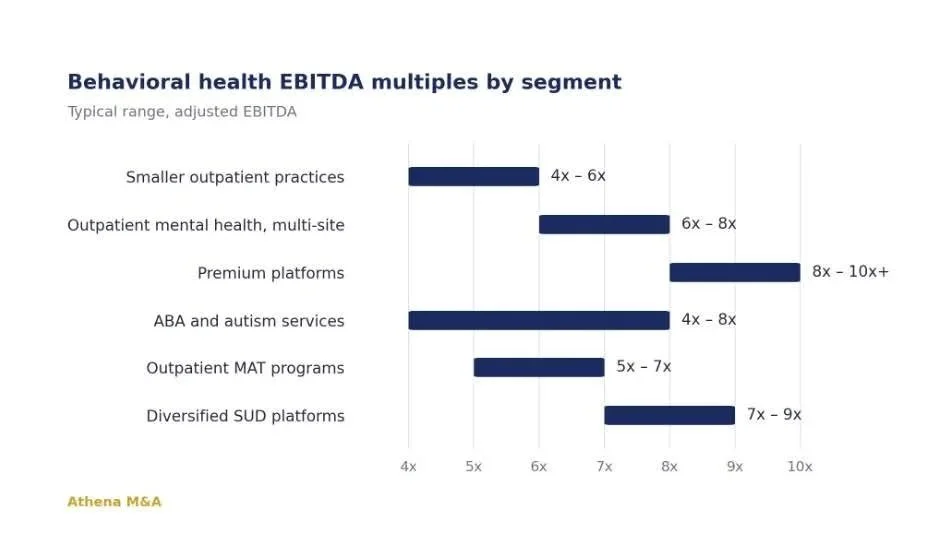
Behavioral health EBITDA multiples by segment. Ranges reflect deals I see in the market but your business could fall outside them in either direction.
A few notes on the ranges:
Outpatient mental health commands the upper end when there are multiple locations, experienced management that isn’t the founder, and strong commercial payer relationships. The commercial mix matters more than most owners expect.
ABA and autism services still draw premium interest, though multiples have moderated from their historic highs. High-quality organizations sit in the stated range; larger platforms occasionally exceed it.
Substance use disorder varies more than any other segment. Level-of-care diversity and payer mix drive most of the spread.
The premium tier isn’t a size category (although size does matter). It’s differentiated specialty, scalable infrastructure, or genuine strategic value to a specific buyer. It’s usually combined with a competitive process where more than one buyer is at the table.
What the range actually means for your business
Take a practice earning $3 million in adjusted EBITDA. Depending on where it falls, that’s somewhere between $15 million and more than $30 million.
The gap between those two numbers is not luck. It’s leadership depth, clean books, referral diversification, compliance posture, and whether a buyer has to compete for you.
That gap is the entire argument for preparing early.
What moves a behavioral health practice up its range
Leadership depth. Founder dependence is the single most common discount. If the practice can’t run for ninety days without you, buyers price that risk.
Clean financial reporting. Accrual-basis financials, defensible add-backs, and a quality-of-earnings analysis that survives diligence. Owners routinely underestimate how much value is lost in diligence rather than negotiation.
Diversified referral sources. Concentration in any single referral relationship is a risk a buyer will make you carry in the price.
Payer mix. Commercial contracts at reasonable rates raise the multiple. Heavy Medicaid concentration doesn’t disqualify a practice, but it changes how buyers model the next three years.
Documented compliance. Credentialing in order, documented processes, no unresolved regulatory exposure.
Specialization. Depth in a defined service line — interventional psychiatry, integrated therapy and med management, a specific population — is worth more than undifferentiated scale in the current market.
Why waiting can cost more than it earns
Many owners assume that if revenue keeps growing, so does the value of the business. That isn’t reliably true.
Healthcare is entering another stretch of reimbursement uncertainty. Medicaid work requirements take effect January 1, 2027, with CMS projecting roughly 2.3 million people losing coverage in FY 2027 and the Congressional Budget Office estimating closer to 5.2 million. A separate CMS proposed rule would cap state-directed payments at Medicare rates, which the agency estimates at $775 billion in total savings over ten years.
Those directed payment caps apply to hospital, nursing facility, and academic medical center practitioner services — not directly to independent outpatient practices. The exposure is indirect: pressure on state Medicaid budgets reaches every rate those budgets fund, and buyers price that risk into multiples long before it appears in your P&L.
Meanwhile, labor costs stay high, compliance expectations keep rising, and technology investment is now a requirement.
So a practice growing revenue 10 percent a year can still lose value if buyers apply a lower multiple to a riskier revenue base. A business worth eight times EBITDA today might command six a few years from now. On $3 million of EBITDA, that’s a $6 million swing driven by nothing you did wrong.
Consolidation is still moving
The buyers are active. Universal Health Services agreed to acquire Talkspace for roughly $835 million, expected to close in the third quarter. BrightSpring sold ResCare Community Living to Sevita in March, after an FTC intervention required divesting 128 intermediate care facilities before the deal cleared. Merakey and I Am Boundless affiliated in June, creating a nonprofit organization topping $1 billion in annual revenue across 12 states.
On the platform side, LifeStance has returned to M&A execution after several years focused on integration. ARC Health and Beacon Behavioral continue disciplined add-on acquisition strategies.
Buyers aren’t buying to get bigger. They’re assembling regional and national platforms with specific clinical capabilities, which means the question isn’t whether your practice is for sale. It’s whether it’s the kind of asset those platforms are built to want.
The other kind of transaction
Not every deal happens on the seller’s timeline.
Spero Health acquired CleanSlate Centers in July, doubling Spero’s footprint to 128 locations across ten states and preserving care for nearly 20,000 patients. But the merger disclosure filed by CleanSlate’s own CEO describes the transaction as necessary to prevent the organization’s closure.
Most owners never expect to become distressed sellers. Reimbursement changes, workforce shortages, a partner’s retirement, or plain burnout can compress a planned transition into a forced one.
The strongest negotiating position comes when you still have time and options.
Preparation pays whether you sell or not
Talking with an M&A advisor doesn’t mean you’ve decided to sell. Most of my conversations with owners start three to five years before they expect to exit, and plenty of them never lead to a transaction.
The questions worth answering are the same either way:
What is my practice worth today?
What’s driving that value?
What risks could pull it down?
What should I be doing now (whether I sell next year, in five years, or never?)
Here’s the part owners tell me they find surprising: the improvements that raise the multiple are the same ones that make the business better to own. Leadership depth. Clean reporting. Diversified referrals. Tight compliance. Systems that scale.
Those investments pay off whether a deal happens or not. And the organizations doing that work are the ones still serving their communities in ten years, under whatever ownership makes that possible.
Frequently asked questions
What EBITDA multiple do behavioral health practices sell for?
In our experience at Athena M&A, most transact between 4x and 10x adjusted EBITDA depending on segment and quality. Smaller outpatient practices typically land at 4x–6x; established multi-site outpatient mental health providers at 6x–8x; premium platforms with differentiated specialties or strategic value at 8x–10x or higher in a competitive process.
How is a behavioral health practice valued?
Buyers apply a multiple to adjusted EBITDA, then adjust for risk. Payer mix, founder dependence, referral concentration, compliance posture, leadership depth, and growth prospects all move the multiple. Two practices with identical revenue can transact several turns apart.
Do ABA and autism practices sell for more?
They still draw premium interest, generally 4x–8x adjusted EBITDA, though multiples have moderated from their historic highs. Larger platforms occasionally exceed that range. It’s an area I work in actively, and buyer appetite there remains real.
How long before selling should I start preparing?
Three to five years, in my experience. The improvements that meaningfully move valuation — building leadership depth, cleaning up financial reporting, diversifying referral sources — all take time. Preparation started six months before a sale mostly limits damage rather than creating value.
Does Medicaid concentration hurt my valuation?
It doesn’t disqualify a practice, but buyers model Medicaid revenue more conservatively heading into 2027 given work requirements and budget pressure. Practices with concentrated Medicaid revenue should expect that exposure to be priced.